



















.jpg?la=en-ZW&h=320&w=720&hash=A40D709EBC2BC33ED5B5438DAE8A3F42)











.jpg?la=en-ZW&h=310&w=720&hash=57A5D8DBDBB70BA989FE342E97FC7B8C)


.jpg?la=en-ZW&h=320&w=719&hash=60BB26AE1EE6030C04BB4E0C1E94B0EC)
.jpg?la=en-ZW&h=306&w=720&hash=85191C5ECD82203B545F5B73E28C65C5)

.png?la=en-ZW&h=320&w=720&hash=7338885F69DE18696FE749CBAEF250C7)
















Sustainability meets fire safety
Q&A with Johnson Controls
Michal Zálešák, Site Quality & EHS Manager, Johnson Controls
Tomáš Protivánek, Fire Detection Product Manager, Johnson Controls
Selecting a fire detection system is more than meeting codes and ensuring safety — it’s a strategic investment in your building’s future. Many facility teams seek information about the sustainability of the products they put in their buildings and of the suppliers who provide them. That’s because the right fire detection products can help support your environmental and sustainability goals.
In this Q&A, Michal Zálešák and Tomáš Protivánek of Johnson Controls answer real questions from building owners, consultants and specifiers across Europe about the sustainability of the company’s fire detection solutions.
Download article


How do Johnson Controls fire detection products support sustainability?
We start with the product design. Where possible, our fire detection products are made with recycled and recyclable materials. And we focus on modular designs to make it easy for customers to separate plastic, metal and electronics for recycling. We have also converted to lead-free manufacturing of PC boards and all internal board manufacturing will be lead-free going forward. And if any boards fail testing, we intend to recover high-value components from those boards to ensure they don’t go to waste.
We also engineer our devices for low power consumption using LEDs and sleep modes. Our high-power loop architecture enables customers to run more devices on a single loop, which reduces cabling and other materials.
Our goal is to go beyond supporting energy efficiency to be resource efficient through fewer materials, longer life cycles and less waste. For example, we recycle cardboard from incoming shipments into packaging materials, turning waste into a reusable resource instead of sending it out for disposal. We also ship fire detection products in reusable cartons which helps us reduce about six metric tons of cardboard waste per year.
What sustainable practices does Johnson Controls use in the manufacturing and distribution of fire detection products?
Our company-wide Johnson Controls sustainability strategy is aligned with the UN Global Compact. A large part of that strategy is our 2030 emissions reduction plan, which includes the following actions:
- Decarbonizing facilities
- Reducing refrigerant loss in manufacturing
- Decreasing fleet emissions through efficiency and electrification
- Transitioning to renewable electricity
Our strategy to reduce emissions in our products and solutions includes focusing on energy efficiency, transitioning to low global warming potential (low-GWP) refrigerants, and addressing embodied carbon. Johnson Controls has already achieved our science-based target to reduce emissions from the use of sold products by 16%.
The following activities have helped reduce emissions at our Ráječko manufacturing plant the Czech Republic:
- Reduced energy consumption to reduce CO2 output - over 1,000 metric tons per year
- Reusing excess heat from air compressors in combination with a heat recovery system to optimize facility heating
- Renovating the lighting and replacing an HVAC pump for greater efficiency
- Involving employees in an energy committee that gathers ideas to reduce energy use
At Ráječko, we’re targeting net-zero operations by 2040. Electricity use has already been cut by about 50% since 2012 and natural gas consumption has been reduced by one-third over the same period. Johnson Controls plans to meet or match electricity entirely with renewable energy by 2040.
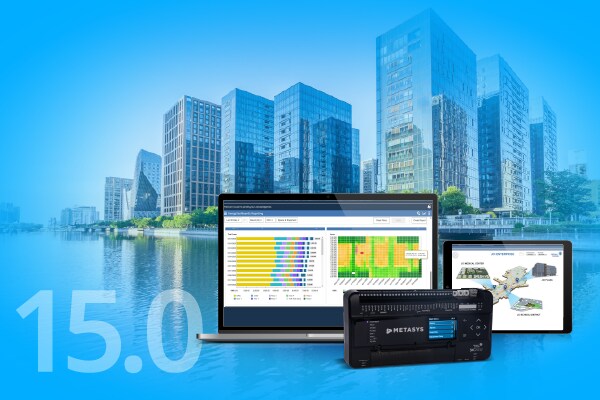
To maximize energy and manufacturing efficiency at the Ráječko plant, we use the Metasys platform for facilities management. We also installed an energy-efficient YORK chiller, which consumes about 40% less energy than the previous chiller.
Since 2012, we’ve reduced water consumption at the Ráječko plant by roughly two-thirds and continue to target further reductions. A significant portion of water used for operations comes from rain collected on the roof and stored in 40-cubic-meter underground tanks. About half of the water used for toilets is supplied this way.
At our fire detection plant in Mexico, we used similar practices to cut water use by 27% since 2017.
All newly-designed Johnson Controls fire detection products are RoHS- and REACH-compliant, which regulates the use of hazardous materials like lead. We also provide an online “green passport” that summarizes the sustainability credentials for fire detection product lines.
What environmental and energy certifications does the company have?
At our fire detection products manufacturing facility in Ráječko, plant certifications include:
- ISO 9001 for quality management
- ISO 14001 for environmental management
- ISO 45001 for occupational health and safety management
- ISO 50001 for energy management
- Certificate of excellence by TUV SUD
- Certified for zero landfill; waste is 100% recycled
- Green Nitrogen Certificate
These certifications are important for customers who want to ensure the fire detection products they purchase contribute to sustainability, efficiency and lower operating costs. For consultants and engineers, these certifications provide frameworks to meet local regulations and global sustainability goals.
Johnson Controls uses an ISO-certified system for environmental and energy management that focuses on continuous improvement across the whole company. This includes regular audits by certification organizations. We strive to go beyond simple compliance to engage the whole company to make continuous improvement part of our culture.
How can customers know their fire detection products will have a long, efficient life?
Our design philosophy is centered on durability, ease of maintenance and more sustainable operations across the full product life cycle. Our fire detection products are designed for long-term performance with exceptional parts and service that encourage customers to maintain products rather than discard. Where possible, we offer spare parts and backwards compatible products for up to 7-10 years after a product becomes obsolete, so customers have the option to extend the lifespan of a product. We also offer a 3-year warranty instead of the 2-year industry standard outside of the United States and Canada.
In addition, by using fewer but higher-quality materials for our products, we simplify maintenance and recycling. Fewer components means less complicated designs along with reduced emissions and energy in the manufacturing process.
How can fire detection products contribute to staff and maintenance efficiency?
Life safety system monitoring tools like SafeLINC offer remote visibility and system management, enabling facility teams to monitor fire detection systems in real time from any location. This reduces the need for on-site inspections and walk-throughs, which saves time and reduces travel. When on-site support is needed, SafeLINC can provide critical information so maintenance personnel come prepared with the right parts and tools for the job.
Remote monitoring tools can also aggregate performance data to prioritize maintenance based on actual system condition. This predictive, proactive approach avoids unnecessary travel and ensures critical equipment gets the proper attention. Remote management tools also help accelerate employee onboarding, enabling teams to get proficient faster.
Looking Forward
By prioritizing sustainability throughout the entire lifecycle of its products, Johnson Controls is demonstrating its commitment to the wellbeing of its customers and the environment. Facilities like the Ráječko manufacturing plant show how sustainability goals can be achieved with the right planning, teamwork and technology working together.
For more information, or to reach out with questions, go to johnsoncontrols.com/corporate-sustainability/sustainability.